Why Your Two Black Pieces Never Quite Match
Quick Answer: Black is not one color - it is achieved with different dye systems depending on the fiber. Nylon and polyester take different dye classes, so a polyester top and a nylon legging start with different undertones, usually blue-black and brown-black respectively. Add fading and gym lighting and the mismatch becomes obvious. Match by fiber content, not by the word black on the label.
If you have ever put together an all-black outfit that looked flawless at home and slightly off in a mirror at the gym, this is why.

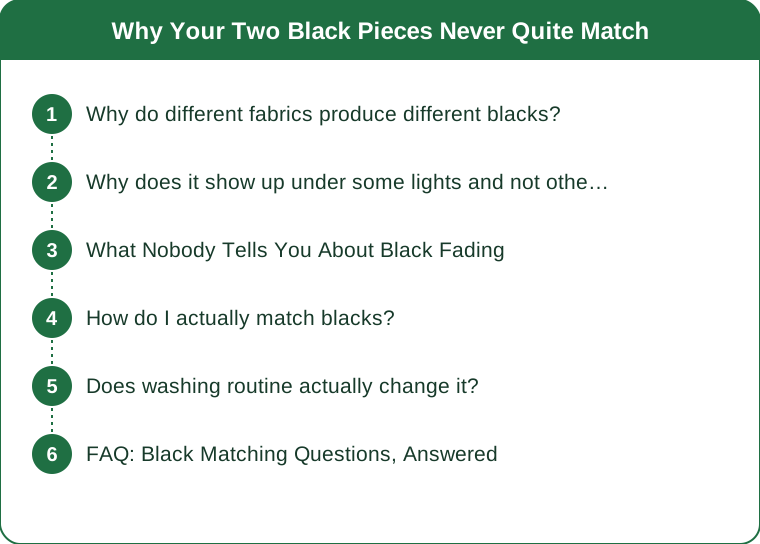
Why do different fabrics produce different blacks?
Because different fibers require chemically different dyes, and no dye produces pure spectral black.
Polyester is dyed with disperse dyes, which need high heat and pressure. The black produced tends toward a cool, slightly blue undertone.
Nylon takes acid dyes, which bond differently and typically produce a warmer, slightly brown or red undertone.
Cotton uses reactive or sulfur dyes, and sulfur black in particular reads noticeably brown-grey.
Spandex within a blend often does not take the same dye as the main fiber at all, which is why some black leggings show a faint lighter cast when stretched.
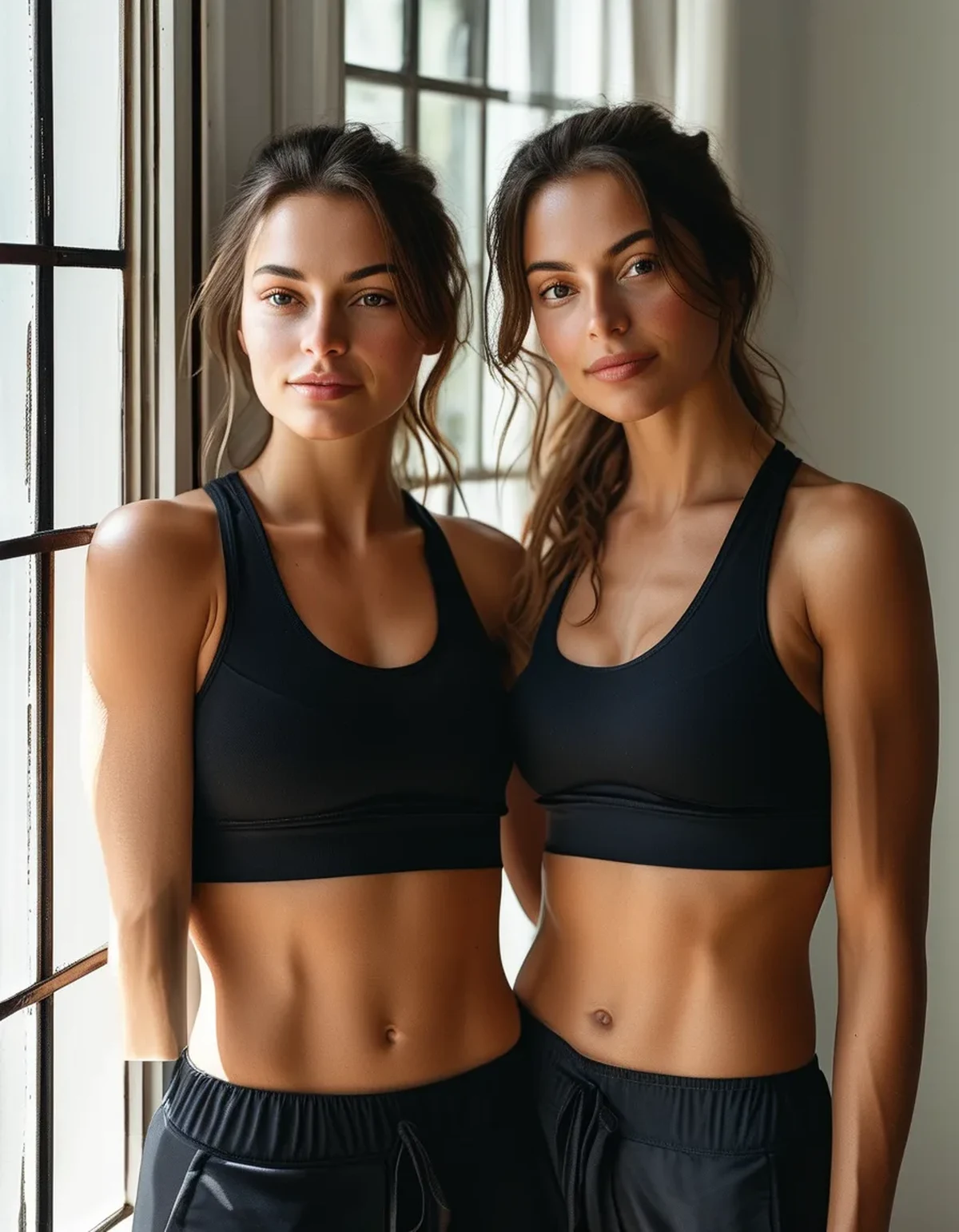
So a polyester sports bra and a nylon legging are not the same black and never were. In isolation each looks black. Side by side, in good light, the difference is visible to most people.
Why does it show up under some lights and not others?
Metamerism. Two colors can match under one light source and clearly differ under another, because they reflect different wavelength distributions that happen to look identical under specific lighting.
Gym lighting is the worst-case scenario. Overhead LED panels often have a high blue component and a poor color rendering index, which exaggerates the blue-versus-brown split between polyester and nylon blacks.
Daylight is the most honest reference. If you want to know whether two blacks match, take them to a window. Store lighting is deliberately flattering and will not tell you.
This is also why an outfit can look coordinated in your bedroom, wrong in a changing room, and fine again in a photo taken outside. Nothing changed except the spectrum hitting the fabric.
What Nobody Tells You About Black Fading
Black does not fade evenly, and the direction it fades depends on the dye.
Polyester black fades toward grey. The disperse dye leaches relatively uniformly, so the piece looks progressively washed out but stays neutral.
Nylon black fades toward brown or rust. Acid dyes lose their darkest components first, which is why old nylon leggings develop that specific tired brownish cast.
Cotton black fades toward blue-grey, and unevenly, concentrating at seams and stress points.
The practical consequence: a matched set bought together will diverge over time if the pieces are different fibers, even with identical care. Six months in, they will mismatch more than they did on day one.
There is one more accelerator worth knowing: sunscreen and body oils break down black dye faster than washing does, particularly on nylon. That is why the waistband and the inner thigh fade first.
How do I actually match blacks?
Four practical rules, in order of usefulness.
1. Match by fiber, not by label. Check the composition tag. Two nylon-spandex pieces will match each other far better than a nylon piece and a polyester piece, regardless of brand.
2. Buy matched sets from the same brand and season. Dye lots vary even within a brand, and a legging bought in spring may not match the same style bought in fall.
3. Compare in daylight before wearing. Thirty seconds at a window prevents the whole problem.
4. When in doubt, break it deliberately. If two blacks are close but not matching, add a third element that makes the difference read as intentional - a contrasting jacket, a cream sock, a colored shoe. Deliberate contrast always looks better than accidental near-match.
That last rule is the most useful in practice, because you already own the pieces and cannot re-dye them.
Does washing routine actually change it?
It changes how fast the divergence happens, considerably.
The main accelerators of black dye loss, in rough order of impact: heat, alkaline detergent, UV exposure, and abrasion.
So the routine that preserves black is short. Cold water. A detergent formulated for darks, which is typically pH-neutral and enzyme-light. Inside out, which puts the abrasion on the interior surface. Air dry away from direct sun. And do not overload the machine, because crowding increases friction.
One addition worth making: rinse activewear in cold water immediately after a sweaty session if you cannot wash it right away. Salt and body oil sitting in fabric for two days does measurable damage to the dye.
Realistic expectation: with careful washing, black activewear holds its depth for roughly 40 to 60 wears. With hot water and a dryer, noticeable fading commonly appears by wear 20.
FAQ: Black Matching Questions, Answered
Can I re-dye faded black activewear?
Generally not successfully. Home dyes are formulated for natural fibers and do not bond well to polyester or to spandex, which often ends up patchy. It also risks damaging the elastane.
Why does my black legging look grey only when stretched?
The spandex within the blend did not take the dye as fully as the main fiber. When you stretch, more of that fiber becomes visible. It is a normal feature of blended knits, not a defect.
Is more expensive black activewear actually blacker?
Sometimes - higher-end pieces more often use a piece-dye process with better penetration and higher dye concentration. But fiber type still determines the undertone, so an expensive polyester black is still a blue-black.
TL;DR:
- Black is fiber-specific: polyester dyes blue-black, nylon dyes brown-black, cotton dyes grey-black.
- Gym LED lighting exaggerates the split; daylight is the honest reference.
- The two fade in different directions, so a mismatched pair diverges further over time.
- Match by composition tag, not by the word black, and buy sets together from one season.
- If two blacks are close but not matching, add a deliberate contrast so it reads as a choice.
As wardrobes shift toward darker colors this time of year, this is the single most useful thing to check before you buy another black piece to go with something you own.
See It in Motion
Seen here: High Waist Yoga Leggings with Side Pockets — shop it on bubblelime.com
Keep Reading
This article is for general informational and styling purposes only. Fit, sizing, and product availability may vary.